
Who Do You Serve
Air Force major Jason Watson's demonstration of leadership and sacrifice

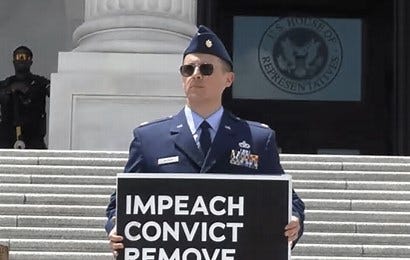
There is a particular kind of courage that only shows up when it costs you something. It feels like the right week to write about it, two days out from a holiday built entirely around people who risked everything on the bet that the country could be better than the government running it.
On Wednesday, an active-duty Air Force major named Jason Watson walked up the steps of the U.S. Capitol in his uniform, in an area where protest is legally prohibited, and read a list of what he believes are impeachable offenses committed by the president and vice president. He cited the War Powers Clause. He cited the Appointments Clause. He cited the Appropriations Clause. He named 13 service members he says died as a result of military strikes on Iran and Venezuela carried out without congressional authorization. Then he set down a sign that read "Impeach Convict Remove," put his hands behind his back, and let himself be arrested.
He is currently on leave from his post as a logistics readiness officer in Poland. He has spent seventeen years in service, much of it in Europe, working alongside NATO. He is not, by his own account, a Democrat. He said he knew next to nothing about Representative Al Green's politics and had joined him anyway, because Green was the only member of Congress willing to force a vote on the question at all.
That last detail is the one worth sitting with.
Watson didn't do this because it was politically convenient. It was the opposite of convenient. Publicly accusing a sitting commander in chief of high crimes while in uniform is the kind of move that ends careers, and by the letter of the UCMJ, it may end his. The backlash arrived within hours, from people calling for his court martial, his dishonorable discharge, his public humiliation as an example to anyone else who might get the same idea. He knew that was coming. He did it anyway.
I keep returning to one line from his speech: "The greatest threat to our Democratic Republic is not a foreign one. It is us, we the people, not just the left or just the right or just the center, all of us together define who we are as Americans, and like it or not, we have all played a part, myself included, in getting ourselves into this mess we are all in."
That is not a partisan sentence. That is an accountability sentence. And accountability is the thing nearly everyone with actual power seems to have quietly opted out of.
Two hundred and thirty-seven House members voted to kill Green's impeachment resolution before it ever reached a real vote. All Republicans and twenty-three Democrats. Forty-seven more voted present, which is its own kind of answer. The people whose entire job is to check executive power took a pass, and it took a major on leave from Poland, someone with no political ambition and everything to lose, to say the quiet part out loud on the actual steps of the building where the decision is supposed to get made.
I am not writing this to relitigate every charge Watson leveled. Reasonable people disagree, sharply, about whether the War Powers Clause was violated, about what "imminent threat" legally requires, about whether impeachment is the right tool or a political weapon dressed up as constitutional process. Those are real disputes and they deserve real argument, not a Substack post pretending the matter is settled.
What I don't think is actually in dispute is this: doing the right thing rarely announces itself as the safe choice. It shows up looking like a career risk, a court martial, a fundraiser for your legal defense, a crowd on the sidewalk chanting "who do you serve" as you're led away in handcuffs. The people who wait for the right thing to also be the comfortable thing are usually still waiting when the moment closes.
Watson served notice, in the most literal sense, that his oath was not conditional on comfort. Whatever you make of the legal merits, that is the part worth carrying with you past the news cycle: the question of what you're actually willing to risk for the thing you say you believe in, and whether you'd still believe it if nobody was watching, and whether you'd say it anyway if they were.
That is, if I'm honest, the whole premise of the Fourth of July. Not the fireworks or the flag sales, but the founding bet that ordinary people, not just the ones with titles, get to hold power accountable, and that doing so might cost them something and is worth it anyway. Two hundred and fifty years later, a major on leave from Poland just made the same bet in uniform, on the Capitol steps, in front of everyone.